SurveyDonkey
Give more reach to your project surveys. A decentralized platform that increases survey reach and diversifies demographics for college students and researchers. Best Use of Google Cloud, SB Hacks VIII 2022.
Inspiration
Most of our teammates, being college students or UX designers, have faced the holy grail of research projects that no one likes to touch: surveys. Surveys are the holy grail since they provide you with the best information required to carry out your projects and/or reach effective conclusions. No one likes to touch them because (and here comes our problem statement) it is tiring to get enough people to fill out your surveys. We wanted to create something that not only increases survey reach but also diversifies and balances the demographics of surveys.
What it does
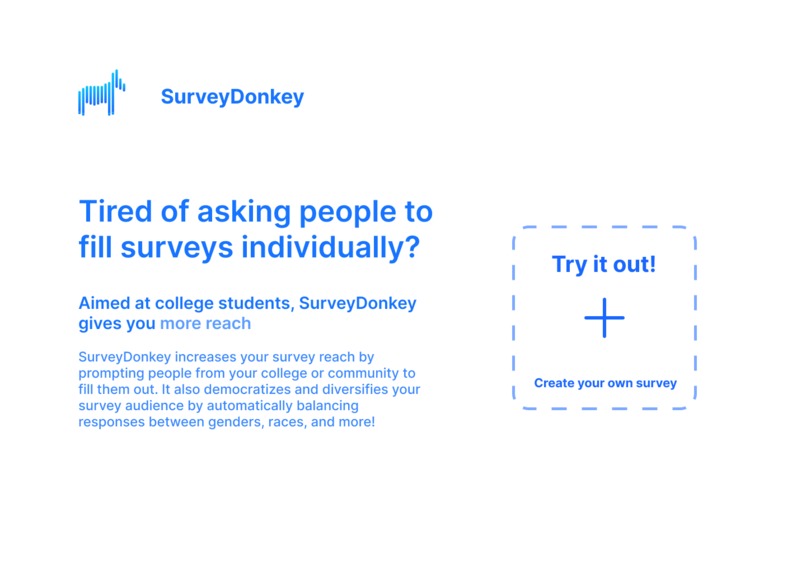
Most college students have research projects that require them to survey people. Often, surveying can become a hefty task as individually asking people to fill out surveys is tedious and not efficient. Often, they end up with very few user cases with little or no diversity. We believe that college students would be willing to help each other out in these cases, so why not make it into a platform? This is where SurveyDonkey comes in.
SurveyDonkey provides a decentralized platform that increases your survey reach by prompting people from your college or community to fill them out. It uses Twilio messaging, Discord bot integration, and AssemblyAI for letting people answer these surveys and for prompting them to fill new surveys. It also diversifies your survey audience by automatically balancing responses between genders, races, etc.!
In addition, we also summarise multiple short-answer responses using NLP (natural language processing) and take audio-based responses if people prefer to talk rather than type (thank you AssemblyAI).
This solves the problems of:
- People creating fake survey responses for fulfilling criteria
- Not enough reach or user diversity in surveys
- Unbalanced reach/demographic (e.g. if a survey has 80% men and 20% women respondents or vice versa, it doesn't give trustworthy results)
- Going through numerous paragraph responses (instead, our AI summarises answers into one)
- ...and more!
Target audiences
- College students: Research projects usually require a surveying component. We partner with colleges to share surveys through portals/SMS/Discord so students can choose to answer them. College students, sharing this common pain, would relate.
- UX designers and entrepreneurs: People who design apps and websites or venture into new products must take user needs and perspectives into account. Same reasons as above.
- Companies: Companies can survey their users/employees using our service by simply integrating their user databases into our application.
How do we balance demographics?
Since there is a point-reward system for completing a survey, if you're of a demographic that is underrepresented in a survey, you get a multiplier on points. If the survey has 80% males and you're female or non-binary, for doing the survey you will get more points. Hence, underrepresented people have more incentive to do the survey.
Incentivization to fill surveys
- We give DonkeyCoins to people who submit surveys, and they can only post their own surveys once they have enough coins/credits.
- College students usually share this pain of surveying and end up filling out surveys for their fellow classmates. A survey about a topic interesting to them is a plus!
- We provide survey-creators with the ability to add cash/coupon lottery-based incentives using a Stripe integration.
How we built it
Frontend:
- Website for creating surveys and checking statistics, built with React and GraphQL.
- App component for answering surveys built on React Native.
Backend:
- SMS-based survey interface using Twilio. Video: SMS bot implementation.
- AssemblyAI for voice input and summarization on the app. Video: implementation.
- MongoDB on GCP to store all data.
- Google Cloud serverless functions and Python for the main backend logic.
Challenges we ran into
- Synchronizing AssemblyAI with React Native
- Maintaining Twilio state across various servers
- CORS issues locally (API on GCP, NGINX blocking requests due to origin). We solved it by installing a CORS Chrome extension for development.
Accomplishments we're proud of
- Overcoming the above challenges
- Working across two opposite timezones (IST and EST)
- Creating a completely working prototype
- Using most available technologies at the hackathon (Twilio, AssemblyAI, Google Cloud)
What we learned
- Researched issues that college students faced and related them with our own.
- Balancing demographics across a service can be a challenge.
- Using AssemblyAI (what a cool tool)
- Complicated Twilio workflows
- Dashboard design
What's next for SurveyDonkey
- Actually partnering with colleges and workplaces and integrating our service into their portals/classroom applications.
- Beta-testing and conducting UX surveys for SurveyDonkey (using SurveyDonkey, lol).